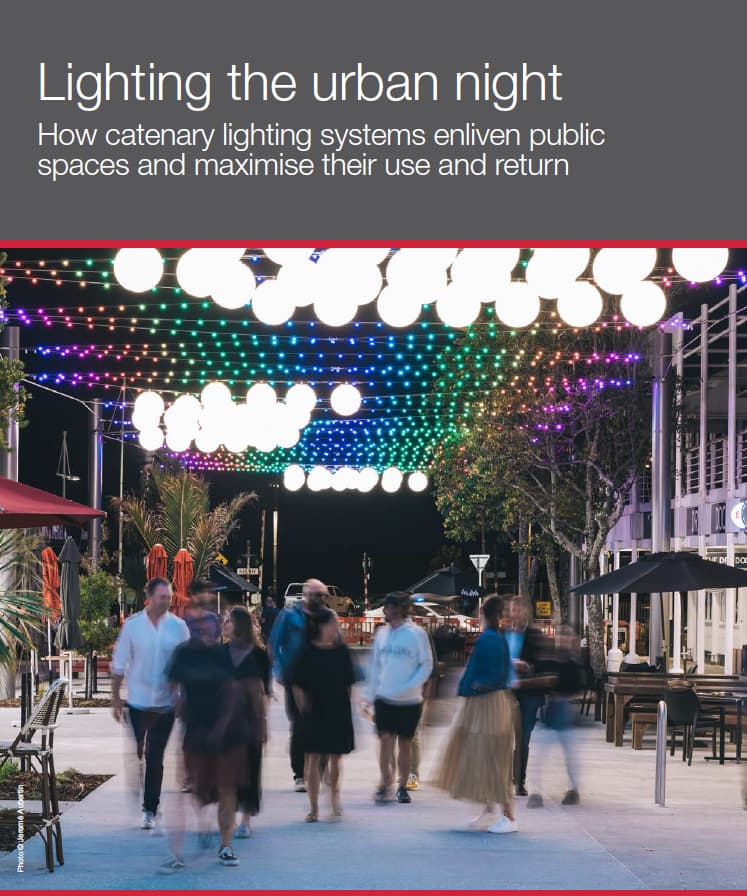
How catenary lighting systems enliven public spaces and maximise their use and return
SRS Group is proud to partner with Ronstan Tensile Architecture, a global leader in tensile architecture and rigging solutions whose innovative systems pair seamlessly with SRS’s specialist installation capability in New Zealand. Together, this partnership allows clients to realise striking, technically complex outcomes in everything from facades and mesh systems through to feature lighting in public spaces.
Introducing “Lighting the urban night”
As part of this collaboration, SRS is sharing Ronstan’s whitepaper, “Lighting the urban night,” which explores how contemporary public lighting can do far more than simply illuminate streets and pathways. The paper looks at how thoughtful lighting design can transform public spaces after dark, improving safety, extending usage, supporting local economies and strengthening the character and identity of neighbourhoods.
Why public lighting matters
The whitepaper begins by framing public space as the social glue of cities and towns, and explains how effective night-time lighting encourages people to linger, exercise, commute and socialise in these areas rather than just pass through them. It also highlights the downsides of conventional street lighting, including light pollution, wasted energy, visual clutter from poles and fittings, and the impact of poor lighting on wildlife, residents and council carbon footprints.
The rise of catenary lighting
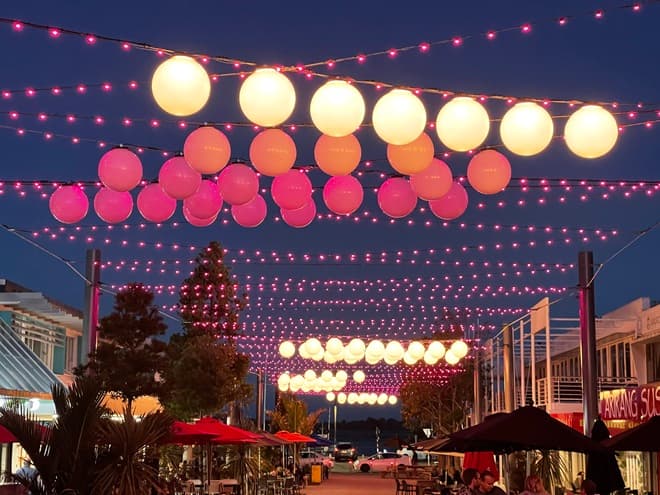
From there, the focus shifts to catenary lighting: systems where luminaires are suspended from tensioned cables spanning across streets, laneways and plazas instead of mounted on poles. This approach embraces a “less‑is‑more” philosophy, placing light exactly where it is needed while freeing up ground-level and overhead space for people, movement, planting and architectural features.
Benefits for people, place and performance
Ronstan’s whitepaper outlines how catenary lighting enables precision illumination, using light and shadow to define routes, create atmosphere and highlight landmarks while improving perceptions of safety and wayfinding. It also explores benefits such as increased night-time use of public assets, reduced visual clutter, opportunities for dynamic and decorative light installations, and better control over light spill and energy consumption compared to conventional solutions.
Planning, design and technical considerations
Designers and asset owners are guided through key considerations for catenary systems, from understanding how people use a space, to defining lighting intent, managing light spill, and selecting suitable geometries such as single spans, grids or central spine systems. The paper stresses the importance of engaging a specialist with tensile and structural expertise, given the high forces, deflection control and long-term maintenance requirements inherent in cable-based systems.
Ronstan’s leadership – and what it means with SRS
The whitepaper closes by positioning Ronstan as a pioneer and global authority on catenary lighting, with more than two decades of experience and landmark projects across multiple continents, including the seminal installation at Melbourne’s Federation Square. For SRS clients, this depth of design-and-build capability, combined with SRS’s local installation expertise, means catenary lighting can be delivered as an integrated, end‑to‑end solution that elevates both performance and urban experience.
Readers interested in rethinking how their projects perform after dark can follow the link to access Ronstan’s full “Lighting the urban night” whitepaper and dive deeper into the case studies, design guidance and technical detail.