SRS Group is proud to partner with Ronstan Tensile Architecture, a global leader in tensile architecture and rigging systems whose expertise perfectly complements SRS’s on-the-ground installation capability in New Zealand. What started as a straightforward supply relationship has evolved into a trusted collaboration, pairing Ronstan’s precision-engineered cable and mesh systems with SRS’s track record of delivering complex, design-driven projects across the country.
Introducing “Framing the Future”
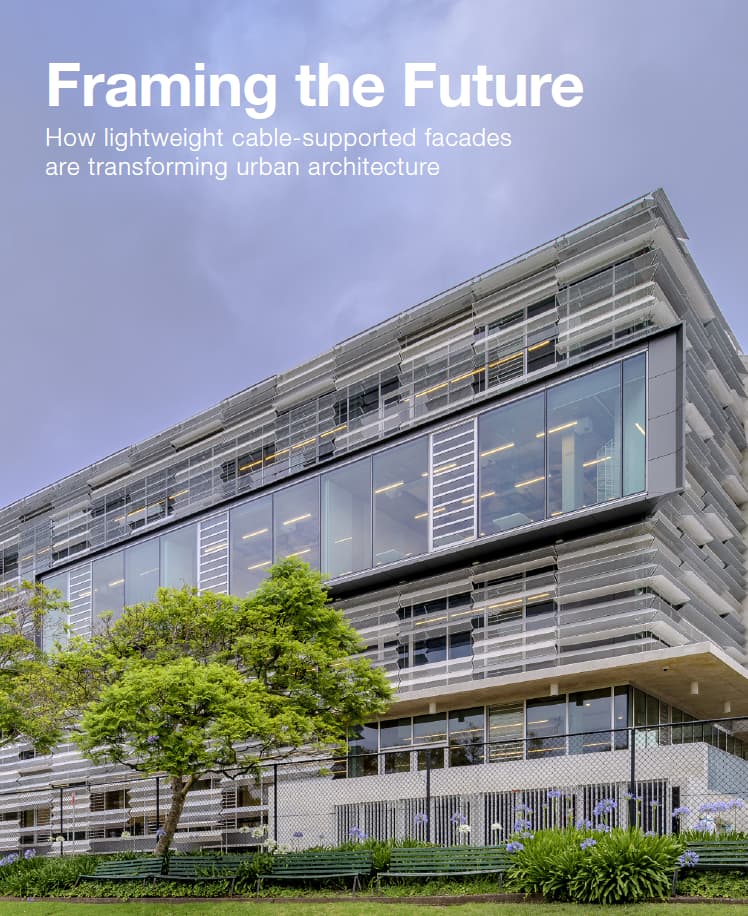
To showcase what this collaboration can achieve, SRS is sharing Ronstan’s whitepaper, “Framing the Future: How lightweight cable-supported facades are transforming urban architecture.” The paper explores how modern facades are no longer just about looks; they’re now central to energy performance, thermal comfort and carbon reduction in commercial and institutional buildings.
What the whitepaper covers
The whitepaper explains how cable-supported facades replace bulky secondary steel with slender, high‑tensile stainless steel cables, dramatically reducing structural weight and embodied carbon while opening up long spans, transparency and free‑form geometries. It walks through different system types, vertical and horizontal cables, cable nets and hybrid solutions, and shows how they can support second‑skin facades, shading systems, green walls and architectural mesh.
Facades that work harder
A key theme is the shift towards “bioclimatic” envelopes, where cable-supported second skins help manage solar heat gain, daylight, ventilation and comfort without relying solely on mechanical services. By suspending perforated panels, mesh or louvres off the main facade, these systems can cut unwanted heat, improve natural light quality and support passive ventilation strategies that reduce HVAC loads and running costs.
Materials, sustainability and performance
The paper also dives into material choices, highlighting stainless steel cables and aluminium panels as durable, corrosion-resistant and highly recyclable components that support circular construction and long service life. Through examples such as the Atmosphere™ system, it demonstrates how a well-designed cable-supported second skin can significantly reduce solar heat gain, lower energy use and improve operational carbon performance over the life of a building.
Why this matters for SRS projects
For architects, engineers and builders working with SRS, the ideas in “Framing the Future” show what’s possible when Ronstan’s tensile systems are combined with specialist local installation expertise. From expressive shading screens to finely detailed mesh enclosures, the principles in the whitepaper underpin the kind of bespoke, high-performance facades SRS and Ronstan are already delivering on landmark New Zealand projects.
Readers who are interested in the technical detail, performance data and case studies can follow the link to access the full “Framing the Future” whitepaper from Ronstan.