Playground shade structures in New Zealand need to do three jobs at once: block harmful UV during some of the most intense summer sun in the world, keep play equipment and surfaces cool enough to touch, and stand up to wind, salt air, climbing children and decades of public use. The most reliable approach is an engineered tensile structure, using a tested shade fabric or membrane on an independent steel frame with marine-grade rigging, designed around the sun path, the site’s wind exposure and the way children actually play. SRS Group delivers this end to end for councils, schools and commercial clients, from CAD design and engineering liaison through in-house fabrication to certified rigging installation.
Ask most New Zealanders about their childhood playground and someone will mention a metal slide that was too hot to sit on by lunchtime. It is a familiar memory, and it points to a problem that has not gone away. New Zealand’s sun is unusually harsh, a large share of our public playgrounds still have little or no shade over the equipment, and the shade that does exist is not always designed to last.
This guide is written for the people who commission, design and maintain play spaces: council parks and open space teams, school property and facilities managers, landscape architects, architects and commercial developers. It covers why shade matters, the main types of tensile shade structure, how to choose fabric, and the engineering decisions that separate a shade structure that performs for decades from one that sags, flogs or fails after a few storms.
Why shade matters for NZ schools and playgrounds
New Zealand’s UV is among the most intense in the world
New Zealand’s peak summer UV levels are roughly 40 percent higher than at comparable latitudes in the Northern Hemisphere, according to the Ministry for the Environment, drawing on long-running NIWA research. The reasons are a thinner summertime ozone layer, cleaner air, and the Earth sitting closer to the sun during our summer. NIWA (now part of Earth Sciences New Zealand) reports that peak UV Index values reach 13 or more in northern New Zealand and around 12 in the south; anything above 11 is classed as extreme.
The health consequences are well documented. Together with Australia, New Zealand has the highest melanoma rates in the world, with 3,116 melanoma registrations in 2022 (Environmental Health Intelligence New Zealand, Massey University). Sun exposure in childhood is a key risk factor, which is why the Cancer Society’s SunSmart Schools programme treats shade as one of its core accreditation criteria.
Most NZ playgrounds are still under-shaded
The research on playground shade is sobering. A University of Otago study of 50 randomly selected Wellington playgrounds found that 95 percent of play equipment had no shade protection at all. A later national study by Otago researchers sampled 559 playgrounds across every territorial authority and found that 60 percent had no shade over play equipment, seats or tables, and playgrounds in more deprived areas were 43 percent less likely to have any shade. In other words, the children with the least access to private shade at home are often the least protected in public play spaces too.
Shade keeps equipment and surfacing safe to touch
UV is only half the story. Researchers at Western Sydney University measured surfaces in 10 Sydney playgrounds and found that dark wet-pour rubber and synthetic turf exceeded 80°C in full sun, while shaded surfaces never reached burn-threshold temperatures. New Zealand summers are generally milder than Sydney’s, so treat those figures as indicative rather than local, but the principle holds: well-placed shade protects skin from contact burns as well as UV, and it extends the hours a playground is genuinely usable in summer.
Comfort and all-weather use drive return on investment
A play space that empties out between 11am and 3pm in summer is an under-used asset. Shade turns it into somewhere families and classes can use through the middle of the day, and a well-designed canopy can offer shelter from light rain and wind as well. For schools, the Ministry of Education adds an important New Zealand nuance: its guidance says school shade should be “warm” rather than “cool”, blocking UV without making outdoor spaces too cold to use for much of the year. That means orientation, height, depth and material choice all matter, not just coverage.
Types of tensile shade structures for playgrounds
Tensile structures work by holding a fabric, membrane or mesh in tension between fixed points, so the material itself carries load rather than simply sitting on top of a roof frame. This gives large, light, sculptural coverage with far less structure than a conventional roof. The main options for playgrounds are:
- Shade sails. Triangular or quadrilateral sails tensioned between posts or building fixings. They are cost-effective, colourful and quick to install, and multiple overlapping sails can follow the sun path across a play area. Their weakness is that they are only as good as their posts, fixings and tensioning; poorly engineered sails are the main source of the problems that give shade structures a bad name.
- Hypar (hyperbolic paraboloid) sails. Four-point sails with alternating high and low corners. The twisted form is stiffer in wind, sheds water more predictably and reads as a deliberate architectural element rather than a stretched rectangle.
- Cantilever and umbrella canopies. Single-post or offset-post structures that keep the ground plane clear, useful where fall zones, surfacing or underground services limit where footings can go.
- Conic and barrel-vault tensile membranes. Engineered membrane roofs over larger areas such as covered courts, outdoor learning spaces or seating zones, typically on custom steel frames.
- Integrated play canopies. Shade, netting, tensile mesh and play equipment sharing the same structural frame, so a climbing tower or net structure also carries its own shade element.
Fabric and membrane considerations
The fabric is the most visible part of a shade structure and the part most likely to need replacing during its life, so it deserves careful specification.
- Knitted HDPE shade cloth. The most common choice for shade sails. It is breathable, lets hot air escape, does not pool water and comes in a wide colour range. Look for fabric tested to AS 4174:2018 Knitted and woven shade fabrics, the Australian standard used by ARPANSA, which classifies fabrics by their Ultraviolet Effectiveness (UVE) rating and human protection category. Ask suppliers for the test report, not just a “UV block” percentage on a brochure, because UV block and shade factor vary noticeably between colours of the same product.
- PVC-coated polyester membranes. Waterproof, so they provide rain shelter as well as shade, and suit outdoor learning areas and covered courts. Manufacturer guidance commonly cites a service life in the region of 15 years or more depending on the topcoat; you may want to verify that against the specific product’s warranty.
- PTFE-coated glass fibre membranes. The premium option for permanent architectural canopies, with manufacturers such as MakMax citing a proven design life of at least 50 years. Higher upfront cost, limited colour range, but excellent fire performance and self-cleaning properties.
- Colour and “warm shade”. Darker colours generally block more UV and glare, while lighter colours feel brighter and cooler. For school spaces used in cooler months, the Ministry’s warm-shade principle may favour higher, more open structures or translucent materials over dense, low, dark canopies.
One practical point that often gets missed: the fabric will likely be replaced at least once in the life of the structure, while the steel frame, foundations, cables and fittings should last much longer. Designing for easy re-fabricing, with accessible fixings and standard edge details, protects the long-term investment.
What makes a playground shade structure safe and durable
This is where SRS Group’s perspective differs from many shade suppliers. The Ministry of Education’s own guidance does not recommend shade sails for schools, citing limited lifespan, high installation and maintenance costs, strain on attached buildings and the risk of weather damage. Those are real problems, but almost all of them come down to engineering and hardware rather than to tensile shade as a concept. Addressing them means:
- Engineering for real wind loads. Sail and membrane loads are calculated for the specific site, exposure and terrain under the wind actions standard, AS/NZS 1170.2, rather than taken from a generic table. Coastal and elevated sites in particular can see loads far higher than a standard backyard sail is designed for.
- Independent structure, not borrowed fixings. Tying sails to existing school buildings or trees transfers unpredictable loads into structures that were never designed for them. Purpose-designed steel posts and footings keep the load path clean.
- Marine-grade hardware and terminations. The corners, cables, turnbuckles and swaged fittings are where tensile structures fail. SRS fabricates these in-house in 316 stainless steel to the same standard used in architectural and marine rigging, with protective coatings such as hot-dip galvanising to NZS 4680 for mild steel frames.
- Anti-climb detailing. The Ministry advises schools to make shade structures difficult to climb and to keep them clear of trees and equipment children could use as a step. Post locations, rail heights and infill details such as X-TEND® stainless steel tensile mesh can be designed together with the play layout to remove climbing routes.
- Coordination with play safety standards. Shade posts and footings must respect the fall zones and surfacing requirements of NZS 5828:2015 Playground equipment and surfacing, so the shade designer and the play designer need to be working from the same plan.
- Consenting clarity. MBIE guidance indicates that shade sails up to 50 square metres, at ground or first-storey level and at least 1 metre from a boundary, generally do not need a building consent. Most council and school playground structures exceed that, and even exempt work must still comply with the Building Code, so producer statements and engineering documentation should be part of the plan from day one.
“A shade sail is a structural element that happens to be made of fabric,” says Luke Tempest, Director at SRS Group, whose background is in architectural and superyacht rigging. “When people tell us sails don’t last, it’s almost always the posts, the fixings or the tension that let them down. Get the engineering and the hardware right and tensile shade is one of the most efficient, good-looking ways to protect a play space.”
How SRS supports councils, schools and commercial clients
SRS Group’s Playgrounds and Shade Structures capability brings rigging, fabrication and CAD design under one roof in our Rosedale, Auckland workshop. For clients, that means one team accountable from concept to handover:
- Early design input. Site walk, sun path and wind exposure review, and coordination with the landscape architect or play designer before footings and layouts are locked in.
- CAD design and engineering liaison. Our design team models geometry, tension and fixings in 3D, and works with structural engineers to produce the calculations and producer statements councils and the Ministry expect.
- In-house fabrication. Frames, posts, brackets, cables and terminations are fabricated in our own workshop. Our Fabrication Manager, Sven Lizamore, leads a team qualified to AS/NZS 1554.6 for stainless steel welding.
- Certified installation. Rigging and installation by our own team, including rope access specialists for high-level work, with tension verified before sign-off.
- Maintenance and inspection. Handover documentation and inspection plans so asset owners know what to check, and when.
“On a playground, every fitting is going to get swung on, kicked and climbed at some point,” says Sven. “So we build the hardware the way we’d build it for a boat: properly welded, properly finished, and with nothing sharp or loose where little hands can find it.”
Case study: Hayman Park Playground, Manukau
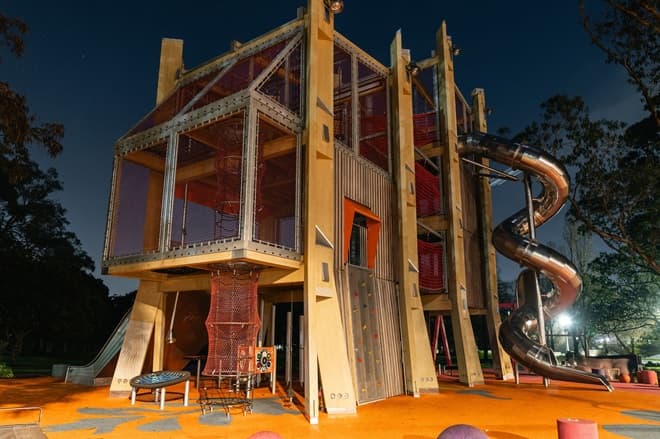
At Hayman Park Playground, part of the Transform Manukau regeneration programme, SRS worked for head contractor HEB Construction on a client brief from the Auckland Urban Development Office (formerly Eke Panuku), with design by Athfield Architects and Wraight + Associates. The playground’s two timber play towers reach up to 12.8 metres. SRS supplied and installed red Carl Stahl X-TEND® stainless steel mesh infill panels, hot-dip galvanised steel frames, painted canopy structures and handrails, all precision-fabricated to integrate with the complex timber superstructure. The project went on to win at the Auckland Architecture Awards 2024 and received an Award of Excellence for Play Spaces at the 2024 Resene NZILA Landscape Architecture Awards.
Hayman Park shows what is possible when canopy, safety infill and play structure are designed and fabricated as one system rather than three separate packages.
Playground shade planning checklist
Before you brief a designer or go to tender, work through these questions:
- Where are children in the playground between 11am and 3pm in summer, and where does the sun sit at those times?
- Which areas need priority shade: equipment with metal or dark surfaces, sandpits, seating, carers’ waiting areas, toddler zones?
- Does the space need warm shade for winter use, rain shelter, or summer UV protection only?
- What is the site’s wind exposure, and is it coastal or elevated?
- Where can footings go without clashing with fall zones, surfacing and underground services?
- Has the fabric been tested to AS 4174, and what is its UVE rating in your chosen colour?
- How will the structure be made difficult to climb?
- Will a building consent or producer statements be needed?
- Who will inspect tension and fixings, and how often, and how will re-fabricing be handled?
- Is there funding for maintenance and insurance? For state schools, the Ministry notes that shade sails are a 5YA priority 4 project and must be insured from board funding.
The Cancer Society also offers free guidance for councils and schools through its SunSmart councils resources and its shade planning guidelines, Under Cover.
Talk to the team about playground shade structures
Whether you are a council officer planning a destination playground, a school property manager weighing up a covered outdoor learning space, or an architect detailing shade into a commercial or residential development, the best results come from involving a specialist early. SRS Group’s rigging, fabrication and design team can review your site, sun path and wind exposure, and help you choose the right structure and fabric before the brief is set.
Talk to the team about playground shade structures, or explore our full capability on the Playgrounds and Shade Structures page. You can also download the playground shade planning checklist to share with your project team.
Frequently asked questions
What is the best type of shade structure for a NZ playground?
There is no single best type. Shade sails and hypar sails suit most neighbourhood playgrounds and offer good value; cantilever canopies suit sites with tight fall zones; and engineered tensile membranes suit larger areas that need rain shelter. The right answer depends on sun path, wind exposure, budget and how the space is used.
How much UV does shade cloth block?
It depends on the product and the colour. Quality knitted HDPE shade fabrics tested to AS 4174:2018 are rated by Ultraviolet Effectiveness (UVE) and protection category, and the figures vary between colours of the same range. Always ask for the test report for the exact fabric and colour you are specifying.
Do playground shade sails need a building consent in New Zealand?
MBIE guidance indicates that shade sails up to 50 square metres, at ground or first-storey level and at least 1 metre from a legal boundary, generally do not need a building consent. Larger structures usually do, and all building work must still comply with the Building Code. Check with your local council for your specific project.
What is a tensile membrane playground structure?
A tensile membrane playground structure uses a coated fabric, such as PVC-coated polyester or PTFE-coated glass fibre, held in tension on a steel frame or cable system. Unlike open-weave shade cloth, membranes are typically waterproof, so they provide rain shelter as well as UV protection.
How long do playground shade structures last?
The steel frame, footings and stainless fittings of a well-engineered structure should last far longer than the fabric. Fabric life depends on the material, colour, exposure and maintenance, with manufacturers commonly quoting longer lifespans for PVC and PTFE membranes than for shade cloth. Plan for at least one re-fabric over the structure’s life and confirm warranties with your supplier.
Why does the Ministry of Education not recommend shade sails for schools?
The Ministry cites limited lifespan, installation and maintenance costs, strain on attached buildings and the risk of weather damage. Most of these risks can be reduced through independent engineered frames, site-specific wind design, high-quality marine-grade hardware and regular inspection, but schools should weigh them carefully and budget for maintenance and insurance.
What is a school shade canopy and how is it different from a veranda?
A school shade canopy is usually a freestanding tensile or framed structure over a play, seating or learning area, while a veranda is attached to a building and typically roofed with a permanent or translucent material. The Ministry of Education treats them differently for funding purposes, so it is worth clarifying which you need early.
SRS Group is New Zealand’s specialist in architectural rigging, structural cable systems and bespoke fabrication, delivering playground, shade, tensile mesh and custom metalwork solutions for councils, schools, commercial developers and civil infrastructure projects nationwide. To discuss a playground or shade project, get in touch with our team.