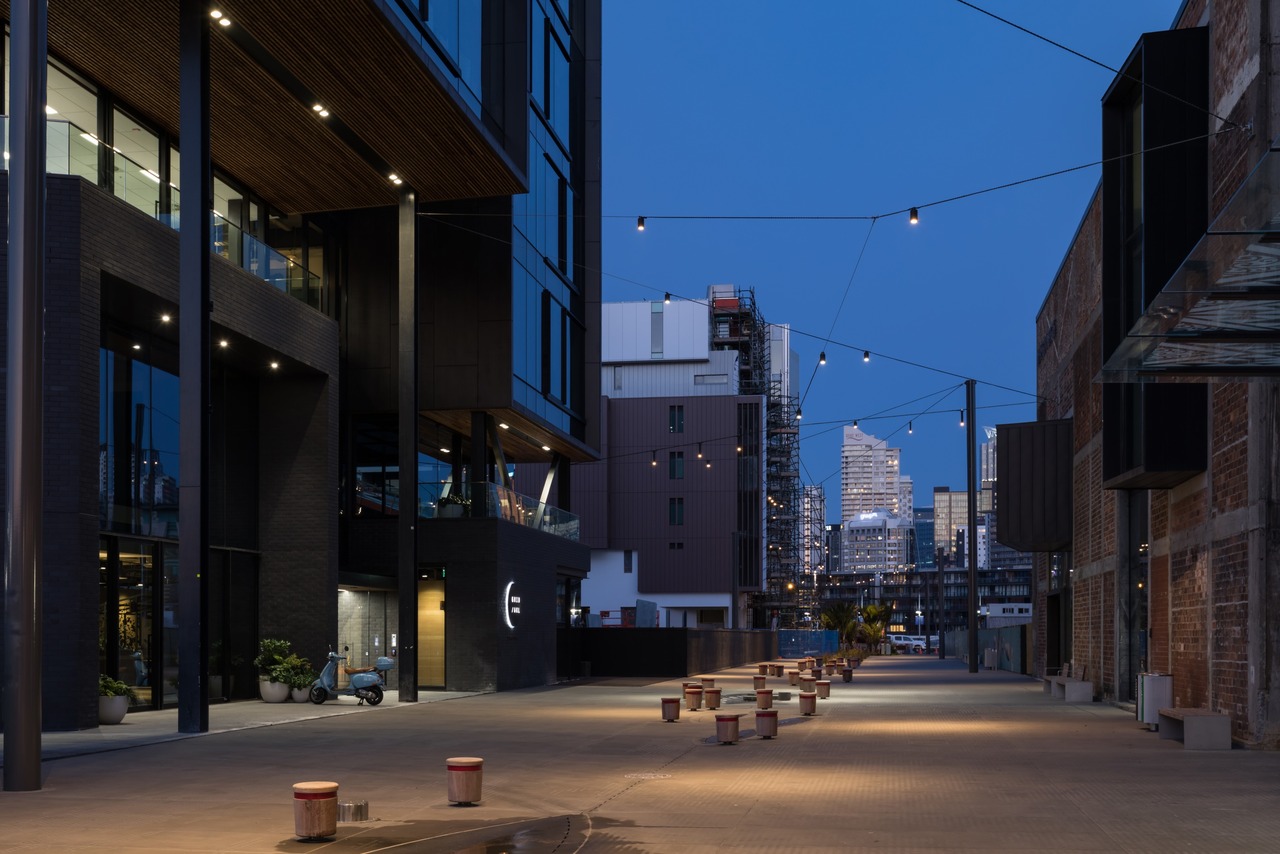
Catenary lighting turns underused, poorly lit laneways into safe, attractive destinations by suspending luminaires on tensioned stainless steel cable networks strung between buildings or poles, removing the need for ground-level poles and clutter. Done well, it is a collaboration between architects, councils and specialist rigging and fabrication teams such as SRS Group, who engineer the cable geometry, structural rods and fixings to hold the lighting scheme safely for decades. The result, evidenced across SRS’s own council and town-centre projects nationwide, is improved night-time safety, longer pedestrian dwell time and a genuine uplift in laneway and street activation.
Introduction
Every town in New Zealand has one: a laneway or side street with good bones and bad lighting. It might sit behind the main retail strip, link a car park to a town square, or run past a row of heritage facades that close early because nobody wants to walk through after dark. Councils and developers increasingly know the fix does not have to mean digging up the ground for new light poles. It can mean looking up.
This post walks through what a catenary lighting project actually involves, from the first site walk to the final tensioning of the cable network, using a composite scenario built from the patterns we see repeatedly across SRS Group’s real council and commercial catenary lighting work; projects like Wharf Street in Tauranga, Taupo’s town centre waterfront, Nelson’s Upper Trafalgar Street, the Queenstown Alliance streets, Auckland’s Tīramarama Way and George Street in Dunedin. If you’re an architect, urban planner, project manager or council officer weighing up a laneway lighting NZ project of your own, this is the sequence you should expect.
The Brief: A Laneway With Potential
Picture a mid-sized New Zealand town centre with a laneway connecting a public car park to the main commercial strip. By day it gets reasonable foot traffic. By early evening it empties out. The council’s own data will often show a sharp drop-off in pedestrian counts after dusk, complaints about safety perception, and hospitality tenants reporting that outdoor seating goes unused once the sun sets.
The brief that lands on a design team’s desk in this scenario is rarely simple. It typically asks for:
- A lighting solution that reads as a destination feature, not just infrastructure.
- No new ground-level poles, footings or bollards that would eat into a narrow footpath or clash with outdoor dining.
- A system robust enough to survive coastal wind exposure and last decades with minimal maintenance.
- Compliance with the NZ Building Code, council engineering sign-off requirements and, increasingly, Crime Prevention Through Environmental Design (CPTED) principles, which New Zealand’s national guidelines have promoted since the Ministry for the Environment first published them in 2005.
- A design that reflects the character and cultural narrative of the place, not a generic catalogue fitting.
This is where a laneway lighting brief becomes a genuine engineering and place-making challenge, and why the projects that succeed bring architects, council teams and a specialist rigging and fabrication partner to the table early, rather than treating lighting as an afterthought once the paving and street furniture are locked in.
Concept Development: Architect, Council and SRS at the Table
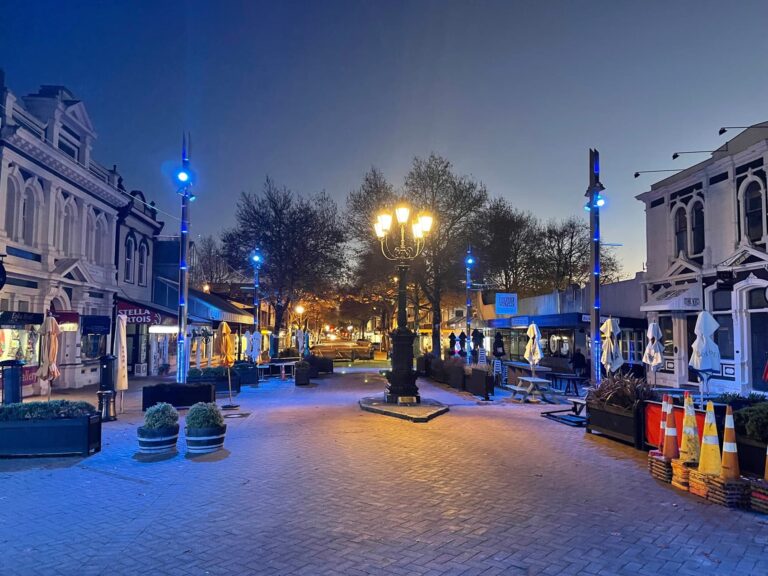
In SRS Group’s real delivered projects, this is consistently where the strongest outcomes are set up. On Nelson’s Upper Trafalgar Street, contractor Walkspace Ltd and architects LandLAB worked with SRS to deliver catenary lighting for what has become a genuinely flexible outdoor dining and events space. On the Queenstown Alliance streets (a partnership of Waka Kotahi NZTA, Queenstown Lakes District Council and delivery partners), LandLAB again led design, incorporating gold-toned poles referencing the region’s mining history and kōwhaiwhai patterns referencing waka travel, with SRS engineering and installing the cable and lighting support system. On George Street in Dunedin, Jasmax and the Ō3 Collective worked alongside Dunedin City Council and SRS to weave Kāi Tahu narratives, including silvery-blue lighting referencing makā (barracouta), into a streetscape that went on to win a Planning and Urban Design award (more on that below).
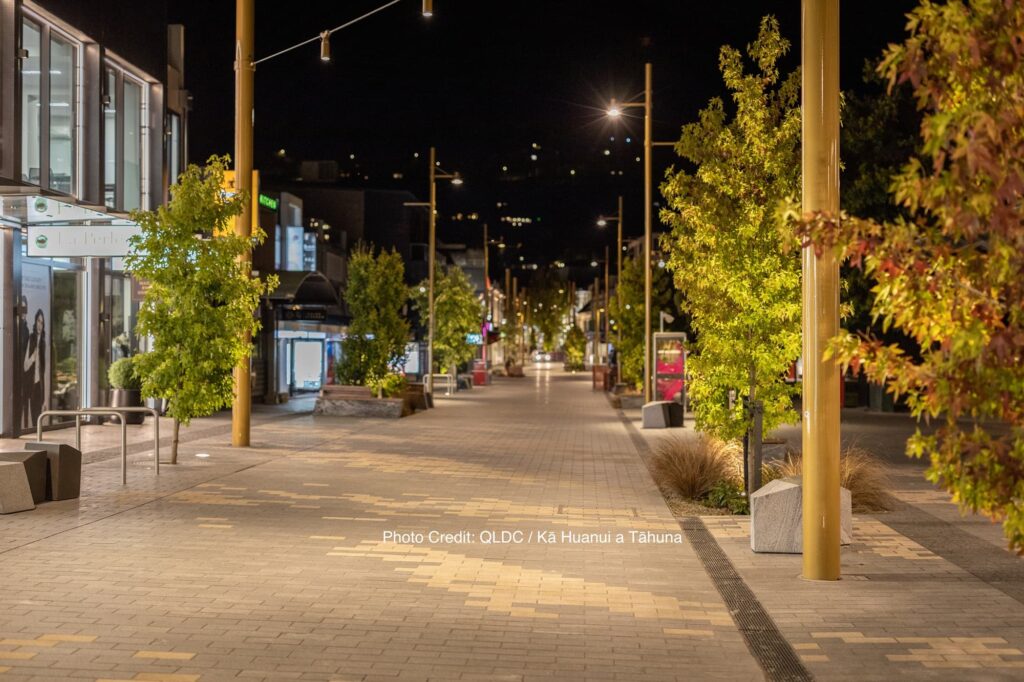
The lesson from all of these is the same: catenary lighting works best as a shared design exercise, not a specification handed down. In our composite laneway scenario, that concept phase typically involves:
- Site and load analysis. Rigging specialists walk the site to assess anchor points, existing building facades, wind exposure and access for future maintenance, well before a single cable is ordered.
- Cultural and place-based input. Where mana whenua, heritage or community narratives are relevant, these shape the geometry, colour temperature and even the pattern the cables trace overhead, echoing the approach on Tīramarama Way, where the lighting design by eCubed referenced the constellations Te Punga (Southern Cross) and Matariki above a site with deep Mahinga Kai significance.
- Council engineering and consenting engagement. PS1 producer statements, structural sign-off and compliance with the relevant sections of Waka Kotahi’s Aotearoa Urban Street Planning and Design Guide, which frames New Zealand’s streets around the concept of “he whenua, he tangata” (land, people and place) rather than traffic flow alone.
- Early rigging and fabrication input, so the architect’s vision for a sweeping, near-invisible cable network is checked against real-world sag, tension and wind load before it is locked into contract documents.
“The projects that go smoothly are the ones where we’re in the room during concept, not just handed a PDF once it’s already through resource consent,” says Luke Tempest, Director at SRS Group. “A cable network that looks effortless overhead is the result of a lot of unglamorous maths done early: anchor point capacity, wind loading, sag ratios. Get that wrong at concept stage and you either compromise the design later or blow the budget fixing it on site.“
Structural Rigging, Rods and Mesh Integration
This is where the project moves from sketch to steel. A catenary lighting system is, at its core, a structural engineering exercise wearing an architectural coat. The luminaires themselves are usually the easy part; the cable network that carries them safely through decades of coastal wind, UV exposure and public use is where the real specification work happens.
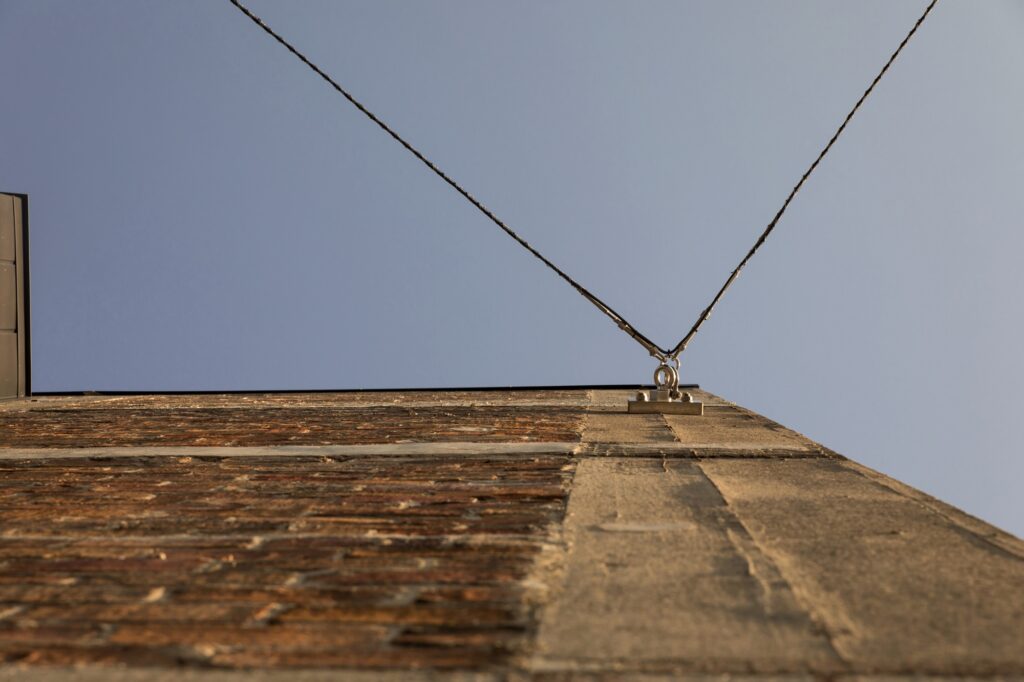
Drawing on the patterns across SRS’s real projects, this stage typically involves:
- Cable selection and structural cable systems. Most of SRS’s delivered catenary projects specify 316 marine-grade stainless steel cable, in diameters from around 6mm to 8mm depending on span and load, often using proprietary structural cable systems such as Ronstan’s ACS2 range engineered in partnership with specialists like Tensys. On the Taupo town centre project, for example, an 8mm Ronstan cable net system was engineered into a 23-cable diagrid pattern across the waterfront. On Tīramarama Way, cables were tensioned to over 1,000kg, with a Carl Stahl mesh sock integrated to manage electrical flex runs discreetly within the structure.
- Custom fittings and fabrication. Off-the-shelf hardware rarely suits a bespoke laneway geometry. SRS manufactures custom cable guides, crossover clamps, swaged end fittings and mounting plates in-house, verified against Loos gauge tension readings before sign-off, so every fixing is matched to the specific anchor conditions on site rather than forced to fit a generic bracket.
- Structural rods and anchor points. Where a laneway’s existing buildings cannot take the full lateral load of a tensioned cable network, custom structural rods and reinforced anchor plates transfer that load back into new or upgraded structural elements, engineered to the same zero-tolerance standard SRS applies across its marine and architectural rigging work.
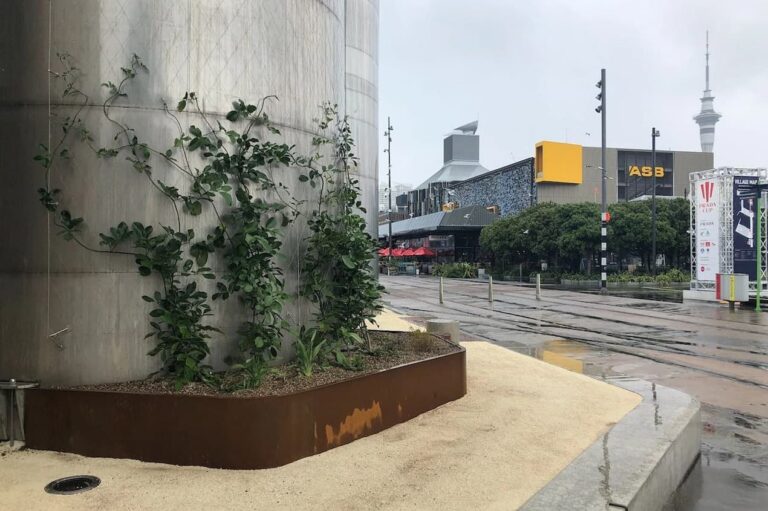
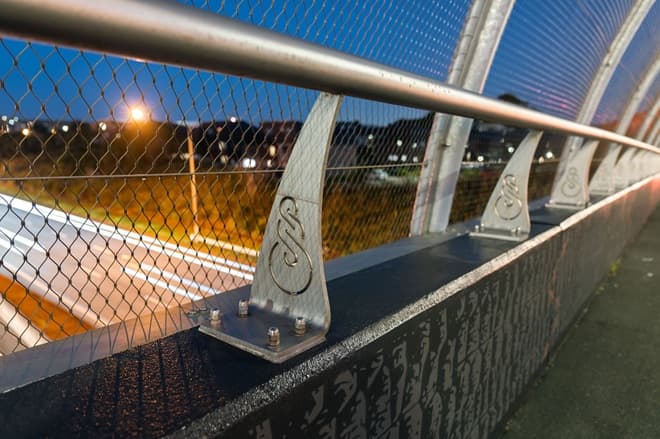
- Tensile mesh integration. On projects where the brief extends beyond lighting alone (shade elements, screening, or a green wall backdrop at the laneway’s car-park end, for example) Carl Stahl X-TEND® tensile mesh can be integrated into the same structural framework, sharing anchor points and load paths with the catenary system rather than requiring a second, competing structure.
- Certified installation. Every cable is fabricated on site to exact measured dimensions and installed by certified rigging professionals, with ongoing inspection built into the maintenance plan.
“People assume catenary lighting is just cable and light fittings, but the fabrication is what makes it last,” explains Sven Lizamore, Fabrication Manager at SRS Group. “Every swage, every clamp, every anchor plate is made to the same standard we’d apply on a superyacht rig; ASNZS 1554.6 stainless welding, verified tension readings, no shortcuts on the hardware because it’s the one thing in the whole system nobody is meant to notice.“
Outcomes: Safety, Dwell Time and Economic Uplift
The point of a laneway lighting project is not the cable network itself; it is what the cable network makes possible. Three outcomes tend to matter most to the people funding these projects: safety, dwell time and economic activation.
On safety, the evidence base is genuinely useful, though it is worth reading with the right caveats. A well-known meta-analysis of street lighting interventions by criminologists Welsh and Farrington, published through the Campbell Collaboration’s systematic review series, found that improved street lighting was associated with meaningful reductions in crime in treatment areas compared with control areas; the original research carried out by Welsh and Farrington recorded a 21% reduction in overall crime across 12 studies in the UK and US. Subsequent updated reviews expanding the study set to 17, reported a lower reduction in crime rates. The update review reported a 14% reduction in overall crime and a 12% reduction in property crime.
Separately, peer-reviewed research on pedestrian reassurance, including Fotios, Unwin and Farrall’s 2015 review published in Lighting Research & Technology, has consistently found that better-lit environments improve pedestrians’ subjective sense of safety after dark, which matters as much as the crime statistics themselves when it comes to whether people actually choose to walk through a space at night. New Zealand’s own national CPTED guidelines, first published by the Ministry for the Environment in 2005 and still referenced in council urban design conditions today, treat adequate, well-designed lighting as one of the foundational principles of safer public space design.
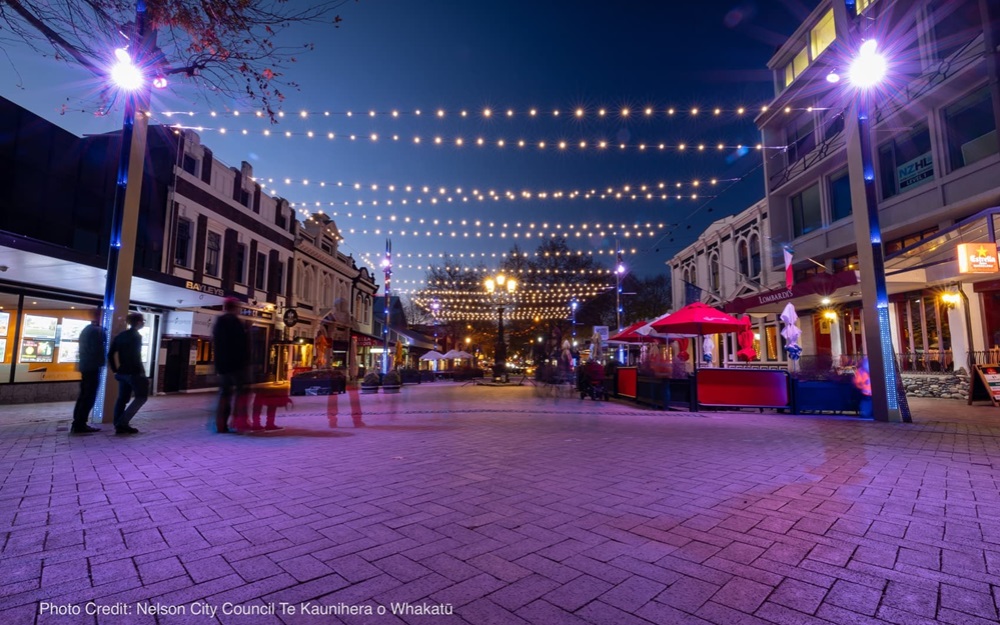
On dwell time and economic uplift, the research is more about a consistent principle than a single New Zealand statistic. Project for Public Spaces, the US-based place-making organisation whose “Lighter, Quicker, Cheaper” methodology has influenced public realm thinking internationally, has long argued that well-designed lighting and seating are among the lowest-cost, highest-impact interventions available to activate an underused public space. A UK-focused evidence review by the What Works Centre for Local Economic Growth similarly concludes that public space improvements can generate measurable local economic benefits, while cautioning that the scale of impact varies significantly by site and should be benchmarked locally rather than assumed. In plainer terms: a laneway that feels safe, looks considered and photographs well after dark is a laneway where people linger, where hospitality tenants can justify keeping the lights (and the till) on later, and where councils can point to a genuine return on a relatively contained capital investment.
George Street in Dunedin is a useful real-world proof point here. Beyond the design accolades (a 2025 Southern Architecture Award for Planning and Urban Design, a Silver Award at the 2024 ACE New Zealand Awards, and an Urban Design Award at the South Island Property People Awards), the project’s brief was explicitly about transforming a historic retail precinct into a safer, more vibrant, pedestrian-friendly destination after dark, and the recognition it has received suggests the design and delivery team got the balance right.
Why Catenary Lighting Outperforms Standard Street Lighting
Most laneway lighting conversations default to more poles. It is worth being direct about why that is usually the wrong answer, and where the industry conversation tends to stop short:
- No new footings in a footpath that is already tight. Catenary systems anchor to existing buildings or discreet end posts, preserving footpath width for outdoor dining, wheelchair access and street furniture rather than competing with it.
- Unbroken sightlines at eye level. Removing ground-level poles improves natural surveillance, a core CPTED principle, because there is nothing at head height blocking a clear line of sight down the laneway.
- The lighting becomes the destination, not just the infrastructure. A well-designed catenary system, especially one carrying a cultural or place-based narrative as seen at Tīramarama Way and on the Queenstown Alliance streets, gives councils and architects a genuine point of difference rather than a compliance box-tick.
- One team, one point of accountability. This is the part most fabrication and rigging suppliers in New Zealand cannot offer, and it is worth naming directly: SRS Group runs in-house CAD design, structural engineering liaison, cable and rod fabrication, and certified rigging installation under one roof. That means the same team that models the sag curve and wind load also swages the fittings and tensions the cable on site, rather than a design being handed between three or four disconnected subcontractors with no single party accountable for the finished result.
- Built for New Zealand’s coastal conditions from day one. Specifying 316 marine-grade stainless steel throughout, rather than mixed-grade hardware that corrodes at different rates, is a decision made once at concept stage that avoids a costly maintenance conversation five years into the asset’s life.
Request a Site Walk-Through With the SRS Team
If your council, agency or development team is weighing up a laneway, plaza or town centre lighting upgrade, the most useful next step is rarely another round of concept sketches; it is getting SRS Group’s rigging, fabrication and design team on site to assess anchor points, structural options and realistic budgets before the brief is locked in. Our team has done exactly this for councils and main contractors from Tauranga to Queenstown to Dunedin, and we would welcome the chance to do the same for your project.
Request a site walk-through with the SRS Group team or explore our full capability on the Catenary Lighting Solutions page to see the engineering and fabrication standards behind every project referenced above.
Frequently Asked Questions
What is catenary lighting and how is it different from standard street lighting?
Catenary lighting suspends luminaires from tensioned stainless steel cables strung between buildings, poles or anchor points, rather than mounting them on individual ground-based poles. It removes the need for footings along the length of a street or laneway, keeps sightlines clear at eye level, and allows lighting patterns to follow a designed architectural or cultural narrative rather than a standard pole spacing grid.
How long does a typical catenary lighting case study project take, from concept to completion?
This varies significantly with span, site access and consenting requirements. Multi-block civil projects, like the Queenstown Alliance streets or Tīramarama Way, have been delivered in stages over several years as part of wider streetscape programmes, while a single laneway project with straightforward anchor points and an existing consent pathway can move from concept to installed system considerably faster. I do not have a single verified average timeframe to quote here; a specific programme should be confirmed with SRS Group’s project team based on your site’s constraints.
What materials does SRS Group use for public space lighting projects?
SRS Group’s delivered projects consistently specify 316 marine-grade stainless steel cable and fittings, often using proprietary structural cable systems such as Ronstan’s ACS2 range, engineered in partnership with structural specialists like Tensys. Custom fittings, including cable guides, crossover clamps and swaged end connections, are fabricated in-house and verified against Loos gauge tension readings before installation.
Does catenary lighting genuinely improve safety, or is that just a marketing claim?
There is a real, if nuanced, evidence base here. Systematic reviews of street lighting interventions (notably the Welsh and Farrington Campbell Collaboration reviews) have found associations between improved lighting and reductions in crime, alongside separate peer-reviewed research showing better-lit streets improve pedestrians’ subjective sense of safety after dark. New Zealand’s national CPTED guidelines treat well-designed lighting as a foundational safer-design principle. That said, the exact scale of benefit varies by study and by site, so treat any specific percentage (including the ones cited in this article) as indicative rather than guaranteed for your location, and verify against the current primary sources.
Who is involved in a catenary lighting project besides the lighting supplier?
A well-run project typically involves the client (often a council, transport authority or main contractor), an architect or urban designer, a structural engineer providing PS1 documentation, and a specialist rigging and fabrication partner such as SRS Group who designs, manufactures and installs the cable network itself. On larger civil projects, this can also include mana whenua consultation and specialist lighting designers.
Can catenary lighting be combined with tensile mesh, shade structures or green walls in the same project?
Yes. Because catenary cable networks, tensile mesh and structural rod systems share the same underlying engineering discipline (tensioned cable, calculated anchor loads, marine-grade stainless steel), they can often share anchor points and structural framework, which is more efficient than specifying separate systems from separate suppliers.
SRS Group is New Zealand’s specialist in architectural rigging, structural cable systems and bespoke fabrication, delivering catenary lighting, tensile mesh and custom metalwork for councils, commercial developers and civil infrastructure projects nationwide. To discuss a laneway, plaza or streetscape lighting project, get in touch with our team.